
To Kill the Sun
Hell is a Red River.

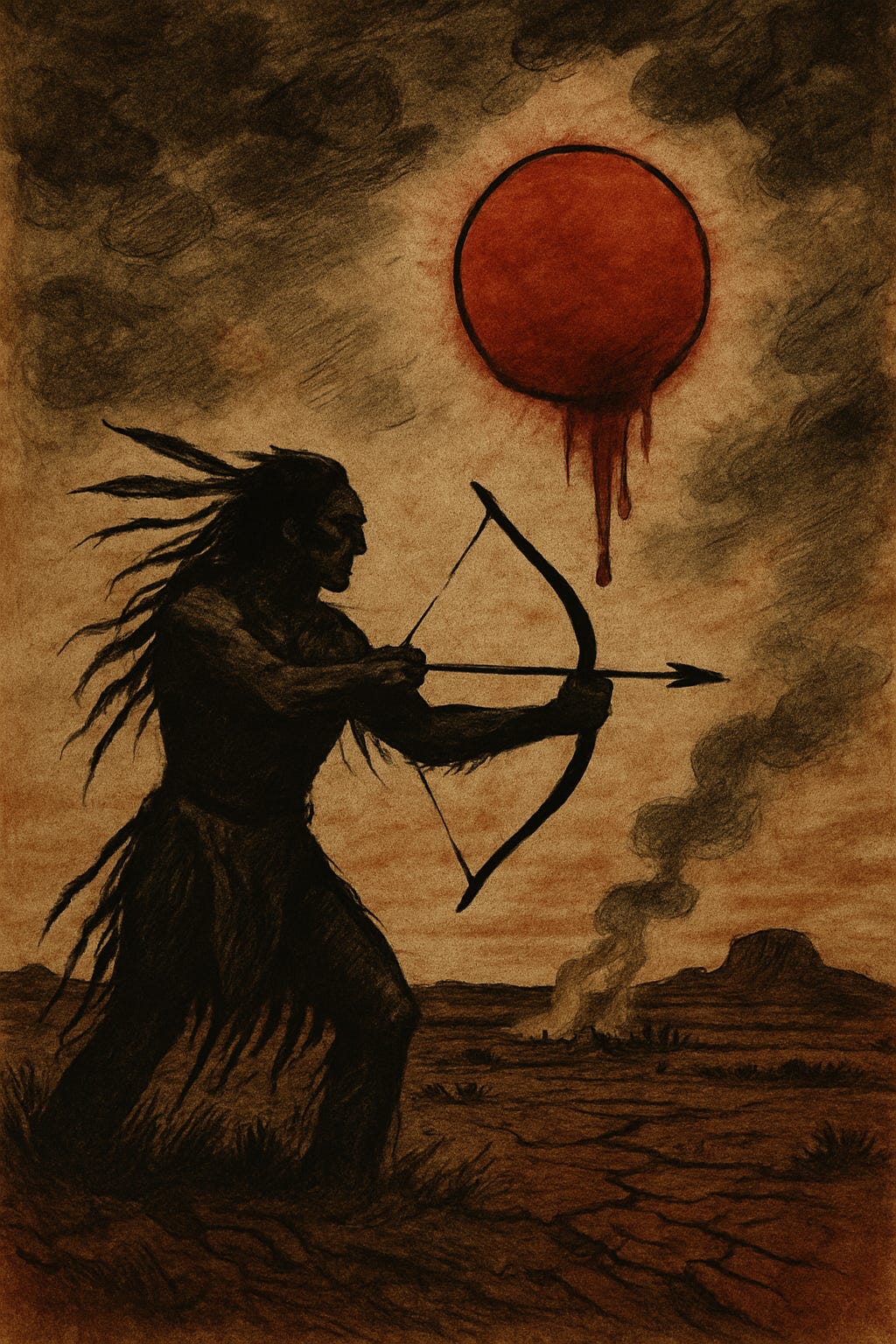
A lot of people have romanticized the Native American tribes to the point that their perception of frontier history resembles a Spaghetti Western. They wear turquoise jewelry bought in kitschy stores that line the streets of places like Sedona and Santa Fe. They tell their grandkids “You’re one-sixteenth Cherokee” with a proud smile, while hoping they never bother to do a DNA test.
This is what the people whose heritage you wear as a trinket were really like…
They came at dawn out of the gulch like beasts loosed from the bowels of the earth, their faces blacked with ash, eyes white with sunless hunger. Painted men, lean and naked, riding bareback and howling like things from the first days of creation.
They struck the cabin with fire and blade. The woman was flayed before the child and the child taken into the smoke, a bundle of twitching limbs hoisted skyward like a tithe. The man they left for last.
Three of them held him down while the fourth took out a blade. Rivers of blood streamed down the man’s forehead as he screamed at a pitch that could have split the cyan sky. The tallest, the one they called Sun Killer, sawed at his scalp with slow deliberation, until it made the sound of wet bark being peeled from a tree as it was torn from his skull.
Later, they camped in a dry arroyo, drinking thick with the blood of mule and man. A squaw, taken in some other raid, danced amid the embers with a white woman’s scalp tied around her belt like a trophy.
The old men watched and smoked. One spoke of the time they cut out the tongues of Utes and fed them to dogs. Another of when they flayed the skin from a Crow warrior and wore it like a mantle. They did not boast. They recounted. Like accountants tallying sums.
Violence was the measure of a man, and cruelty the grammar of their days. No god watched. No judgment awaited.
Only the wind through the cholla and the sun beating the earth to dust.
They rode out from the burned hills like revenants of an older order, men unbeholden to god or treaty, their mouths painted in ochre grins and their eyes hollow as spent cartridges. They were not warriors. They were priests of a religion so old it had forgotten its name, and its rites were fire and mutilation.
The Comanche came first, scouring the plains with a violence that preceded language. They split the tongues of Pawnee children and nailed them to trees, so the wind might make them speak. They gelded Kiowa men and held the sacks up like trophies, took fingers and braided them into hair crusted with old gore and louse. They warred not for land, nor honor, nor even vengeance, but because to kill was to affirm the world, to burn it into being with each stroke of the knife.
Their shamans fed peyote to boys as young as nine and watched them carve each other in fevered rite. Those who lived were men. Those who wept were buried to the neck and left for the wolves to feed on. They believed the entrails of the dead could augur victory. They believed a woman’s scream could summon rain. They flayed captives and wore their skins as second hides, not from madness but from memory.
The Apache rode harder. They buried thorns beneath the fingernails of their captives and set fire to their own wounded. They signed no treaties and accepted no surrender. They made no noise in the night save for the dragging of scalps upon the stone. They once cut the eyelids from a farmer, that he might watch them rape his wife, and when she was spent they drowned her in a creek and made him drink of it.
They did not believe in mercy. Mercy was a weakness of the corn-eaters, the pale men who built fences around the horizon and cried out when their children were taken. The Lakota and the Sioux called the Whites “Wasichu,” meaning “one who takes the best meat.” And so this incursion was repaid by taking their lives in as cruel a manner as was available to them.
The Apache took. They took and they burned and they vanished into the rock like smoke returning to the sky.
As for the Comanche, they had no word for mercy. The closest they came to it was “to relent” or “to spare,” and since there was no glory in relenting or sparing, they had never even conceived of the idea of something resembling mercy.
The defeated were either killed or enslaved, with whatever happened before the first option or after the second being entirely up to the impulses of their captors. Such was their right by conquest. These were the tribes who rode the endless plains. Each tribe the knife of its own god. Each raid a scripture written in blood and recited in the cries of the vanquished.
And the land bore them all. It bore their bonfires and fetishes, the bones they left stacked like cairns to mark the places where the old gods still walked. There was no peace, only pauses. No justice, only the blade.
This was their dominion. Not a nation but a storm without end.
“Why do they call you Sun Killer?” a younger Brave asked with a sheepish grin.
He turned towards him with eyes which reflected the fire like two obsidian stones, “It is said among the old ones, when the blood of too many mothers soaks the ground, one will rise to kill the sun. And nothing will be left but the bones of the earth.”
I need more of this!
I had no idea of the cruelty they used on their own as well as the “white people”.
Your research in history is amazing, Danny. Thank you for the added insight of truth.